

Real organic Instagram growth means followers coming in because of content and engagement rather than ads or shortcuts. For most accounts, that means somewhere between 5 and 15% per month, and that range assumes consistent effort. Some niches move faster. Most accounts grow more slowly than the case studies suggest.
This covers what’s actually working for organic growth on Instagram right now, what stopped working, how much time it takes, and when it makes sense to get help.
In this guide: what counts as organic growth, realistic growth rates by account size, the five strategies that work, what to stop doing, the time cost of doing it yourself, and how to decide between DIY and a growth service.
Table of Contents
What Counts as Organic Growth (and What’s Just Faking It)
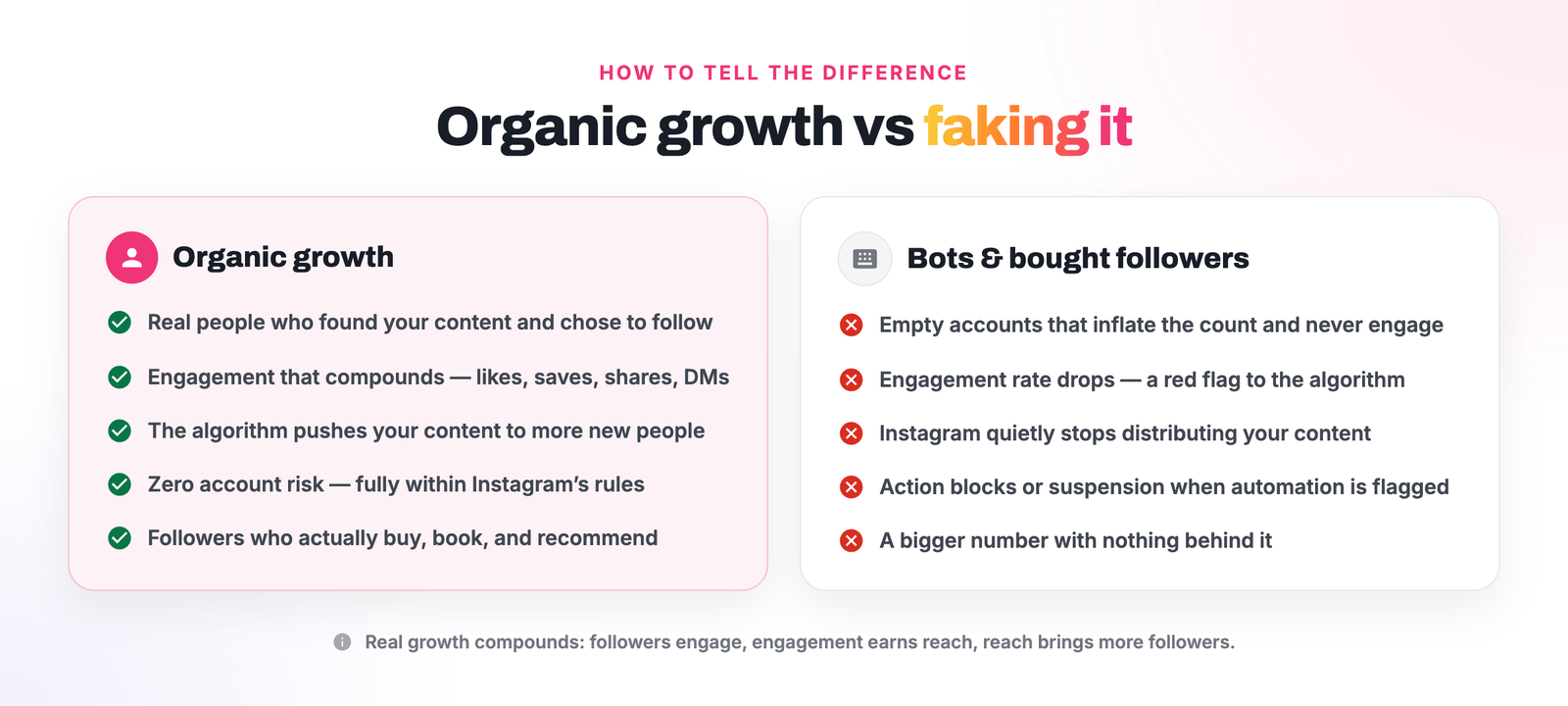
Organic Instagram growth is real people finding your content, liking what they see, and choosing to follow. Instagram is much better at catching automation than it used to be, and the consequences are more serious. Accounts flagged for non-human behavior face action blocks, shadowbans, or suspension. But even before it gets to that, bought or bot-generated followers don’t engage, and low engagement tells the algorithm your content isn’t worth pushing to anyone.
Real organic Instagram follower growth compounds. Real followers engage, engagement signals reach, and reach brings in more followers.
How Fast Should You Expect to Grow?
Most growth guides skip this part, or bury it in optimistic language. Here’s what organic growth on Instagram actually looks like:
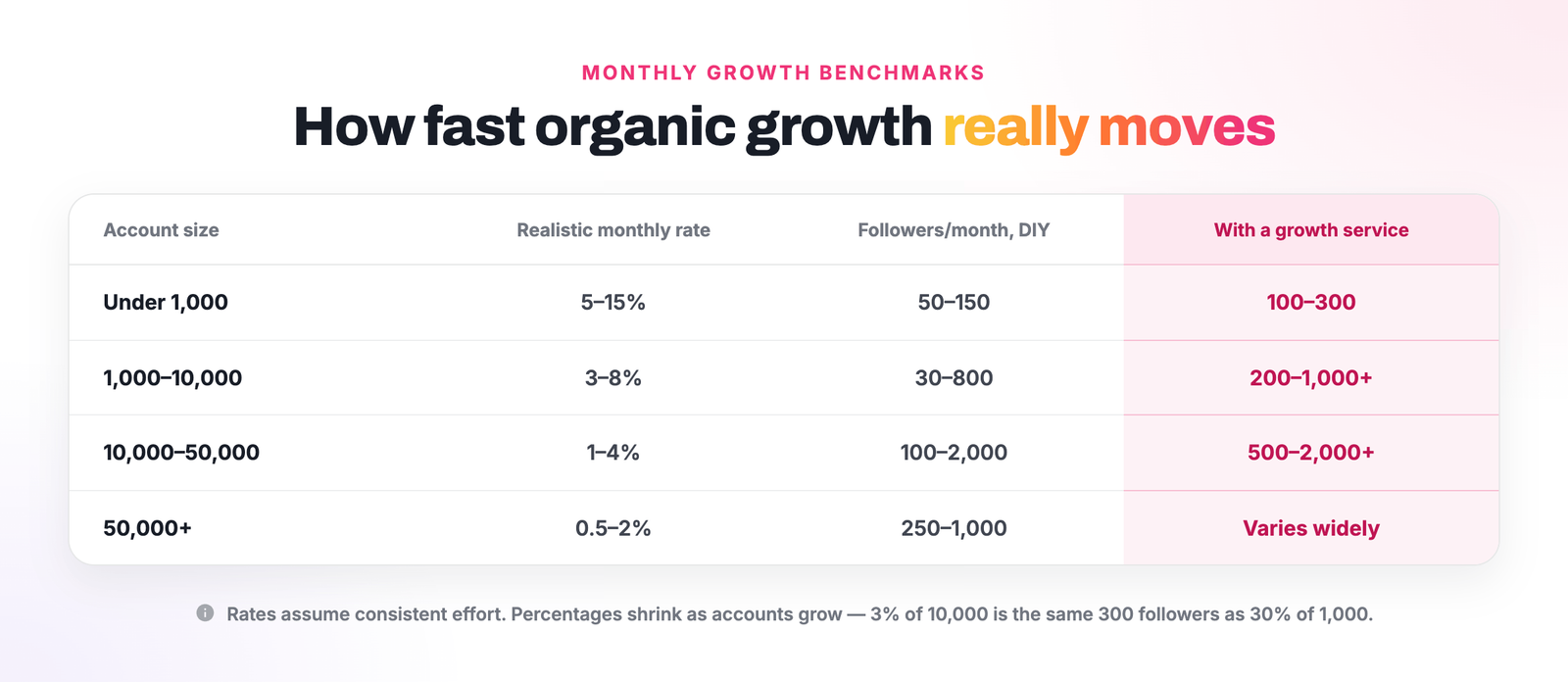
Growth rates slow as accounts get larger – that’s just how it works. A 3% monthly rate on a 10,000-follower account is 300 followers, the same as a 30% rate on a 1,000-follower account. Comparing percentages across different account sizes doesn’t tell you much.
Niche matters too. Accounts in food, fitness, interiors, and parenting tend to grow faster than B2B or service accounts, where the potential audience is just smaller.
Five Things That Actually Grow an Account
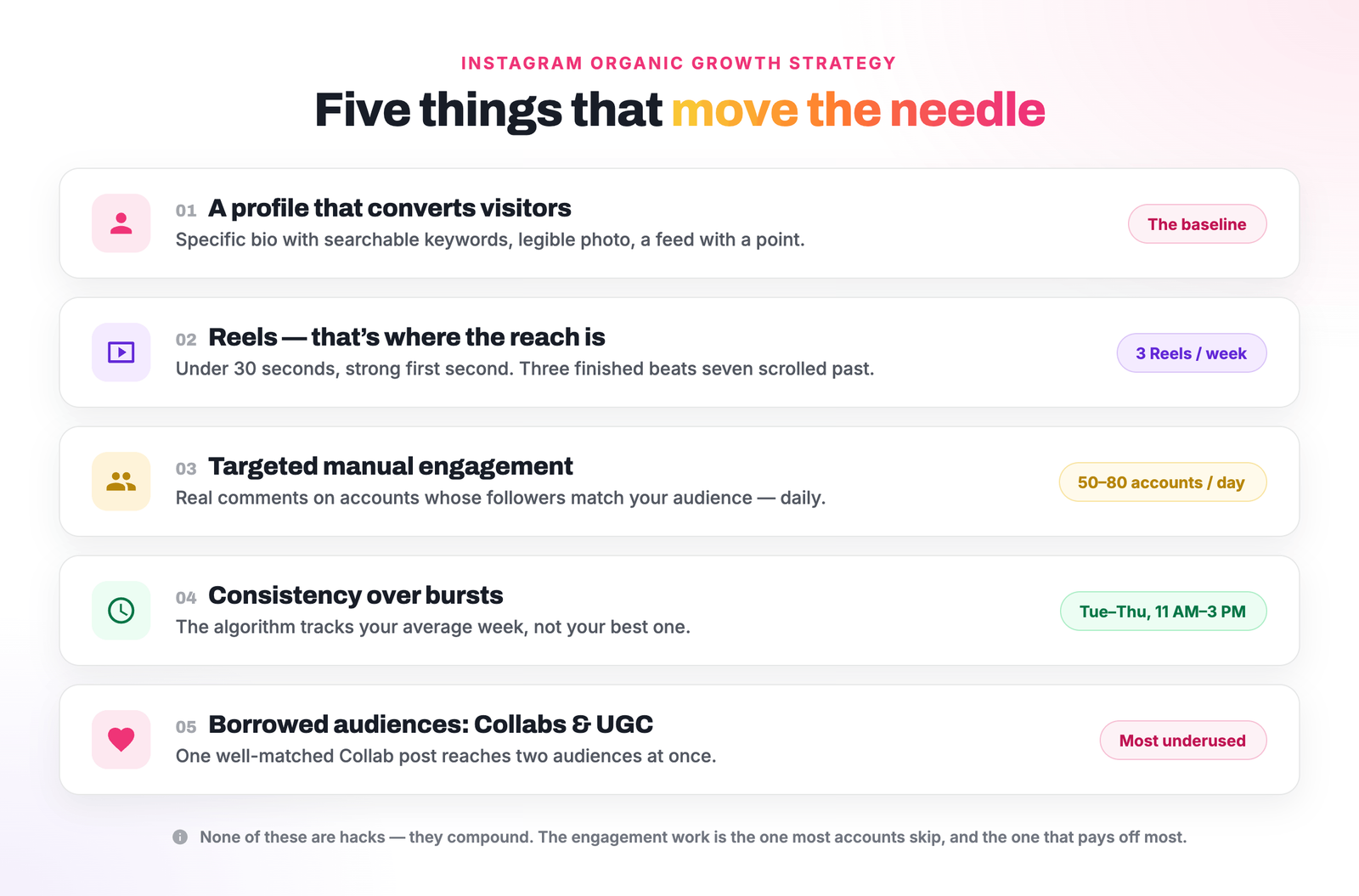
Most advice for organic Instagram growth covers the same ground: post consistently, use hashtags, engage with your community. The Instagram organic growth tips below are different — this is what actually moves the number.
A Profile That Turns Visitors Into Followers
Your profile is doing a job before anyone sees your content: convincing a stranger that following you is worth it. A bio that’s specific about who you are and what someone gets from following, a profile photo that’s legible at small sizes, and a feed that looks like it has a point. That’s the baseline.
Instagram uses profile completeness as a signal when deciding which accounts to surface on Explore and in recommendations. A half-empty bio is a flag, not a neutral.
Bio keywords are also worth paying attention to. Instagram indexes profile text for search. A bakery that mentions its city and what it makes will show up in relevant searches. A generic tagline won’t.
Reels, Because That’s Where the Reach Is
A static post goes to your existing followers. A Reel goes to people who’ve never seen your account, through Explore and the Reels tab. That’s the difference, and it’s why Reels are the foundation of any Instagram organic growth strategy built around reaching new people. Most Instagram organic growth strategies worth following start here.
Short wins, under 30 seconds. The first second determines whether anyone watches the rest. Content that teaches something quickly, shows a process, or takes a clear position tends to do well. TikTok reposts with the watermark still on don’t – Instagram pushes them down. Neither does tips content that’s the same as from every other account in your niche.
Three Reels a week that people finish watching beats seven that get scrolled past.
Targeted Engagement: Slow, Manual, and It Works
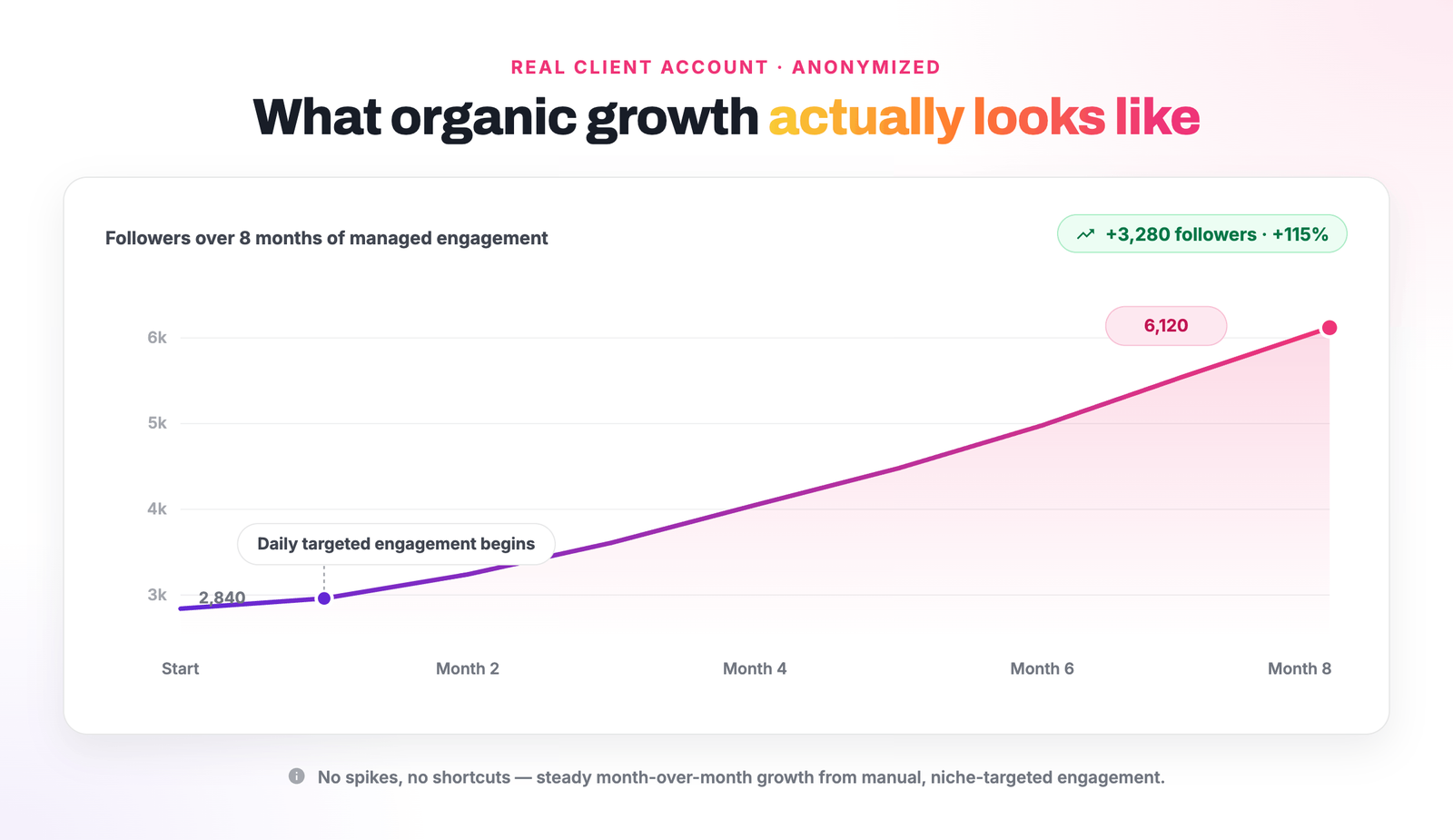
The fastest way to grow organically without creating more content is targeted manual engagement: finding accounts in your niche each day, engaging with their content genuinely, and making your profile visible to the right people.
Targeted is the word that matters. Liking 200 random posts does nothing. Leaving real comments on posts by accounts whose followers match your target audience does. It pulls attention to your profile, and a good profile converts that into follows.
This is also the method that’s hardest to fake at scale without automation risk. At SocialStud.io, this is the core of what our growth managers do: manual, niche-specific engagement, 50–80 accounts per day, tracked daily.
Showing Up Consistently (and at the Right Time)
Seven posts in one week and nothing for three weeks after is not a strategy. The algorithm isn’t tracking your best week; it’s tracking your average one. Three posts a week, every week, will outperform an inconsistent account that occasionally bursts with content.
Timing matters, though less than most guides suggest. Tuesday to Thursday, 11 AM to 3 PM in your audience’s time zone is where most accounts see the strongest engagement. Full breakdown of the best time to post on Instagram. Your own Insights data will always be more accurate than any general benchmark, so use this as a starting point.
Borrowing Audiences: Collabs and UGC
Collabs are one of the most underused growth tools on Instagram. Find an account in a complementary niche with a similar following size, agree on a joint post, and Instagram’s Collab feature puts it on both profiles simultaneously. One well-matched collab can bring in more relevant followers than weeks of hashtag optimization.
User-generated content works on the same principle. When a customer or follower tags you in their own content, their audience sees it at no cost to you. Making it easy to do, reposting when it happens, and occasionally asking for it directly all help.
What Stopped Working (Even Though Everyone Still Does It)
- Follow-unfollow: Instagram flags it, the followers don’t stick, and the ones that do don’t engage.
- Buying followers: the count goes up and the engagement rate drops, which actively hurts how the algorithm distributes your content.
- Hashtag stuffing: Instagram’s own guidance recommends 3–5 hashtags. Using thirty reads as spam.
- Engagement pods: Instagram now identifies coordinated behavior patterns, and the reach lift doesn’t materialize.
- TikTok reposts with the watermark visible: Instagram deprioritizes these. Remove it before uploading.
The Part Nobody Mentions: How Many Hours This Takes
Here’s what running a serious organic growth effort actually costs in time each week:
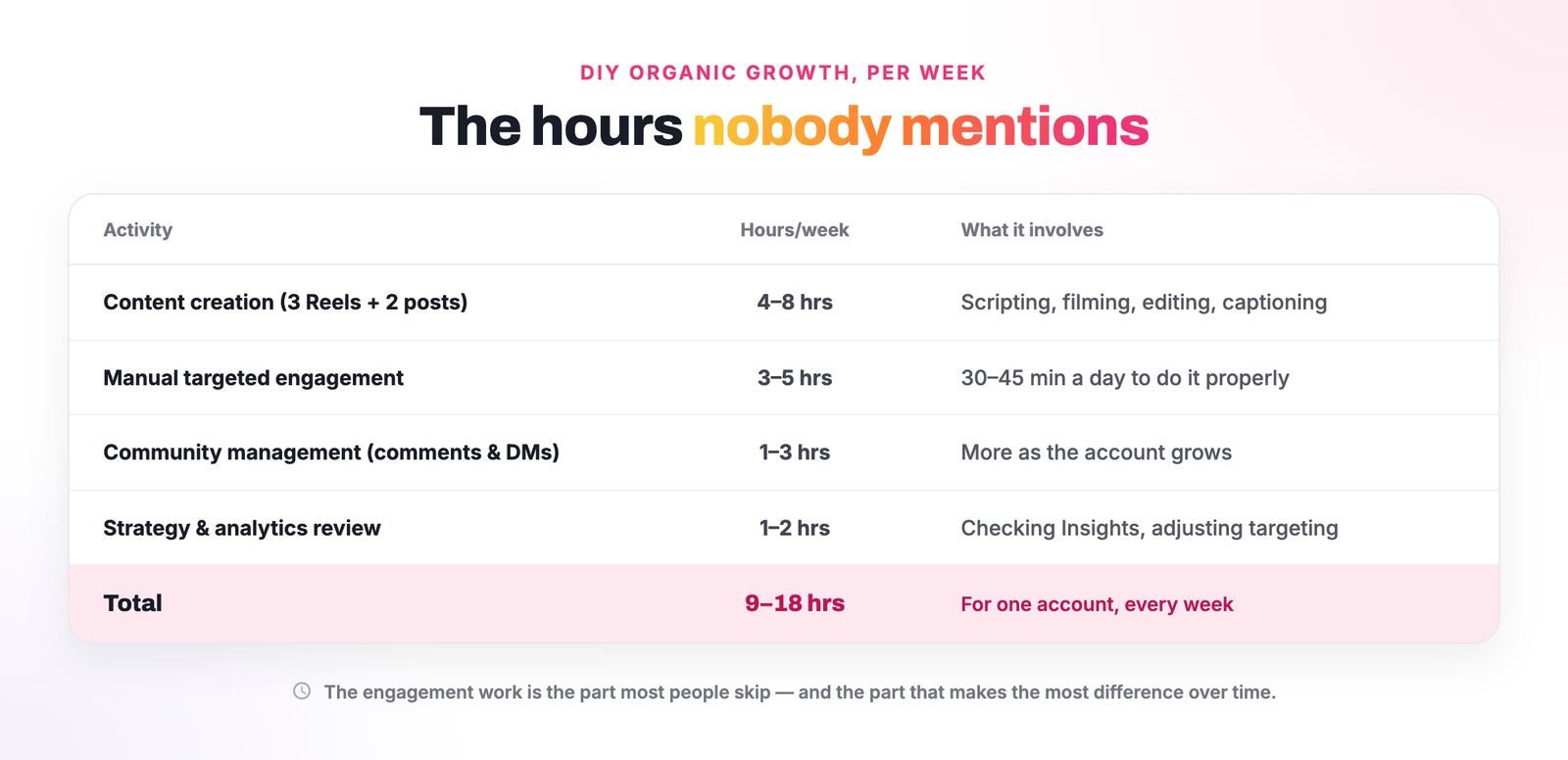
That’s 9 to 18 hours a week, for one account. If you’re also running a business, that’s a real chunk of time. The content side, especially, can’t be cut back without the numbers reflecting it pretty quickly.
Most people skip the engagement work because it’s repetitive and nothing visibly happens for a while. It’s also the part that makes the most difference over time.
Doing It Yourself vs Hiring Help: How to Decide
Honest answer: it comes down to time, not preference.
DIY makes sense if you have 10+ hours a week to put into Instagram, you’re still figuring out your niche and audience, or a monthly service fee isn’t in the budget right now.
Getting help makes sense if: your time is better spent elsewhere in the business, you’ve been consistent for 6+ months, and growth has stalled; you want the engagement work handled by a real person (not automation), or you need measurable, trackable progress without the time investment. When evaluating an Instagram organic growth service, and organic Instagram growth services generally, a few things matter: clear methodology (they should tell you exactly what they do), reviews on Trustpilot or Google rather than just their own site, no follower guarantees (real growth doesn’t run on a delivery schedule), and human-powered engagement rather than automation. The best organic Instagram growth service will walk you through all of this before you ever take your money. Services offering human-managed organic Instagram growth for under $50/month are almost certainly running scripts. See the full comparison of Instagram growth services before committing to anything.
Grow Without Faking It
The best organic Instagram growth comes from time, consistency, and someone actually working it every day: finding the right accounts to engage with, posting content that earns attention, and adjusting based on what’s working.
Every account at SocialStud.io gets a dedicated growth manager who handles that engagement work manually, tracks it daily through Google Sheets, and adjusts targeting as the account changes. Start growing with real human engagement; see pricing.
Frequently asked questions about organic Instagram growth
How often should you post on Instagram to grow?
3–5 times a week is the range that works for most accounts. The number matters less than the consistency – three posts a week without breaking rhythm will outperform someone who posts daily for a month and disappears. For Reels specifically, 2–3 a week is enough.
Is it easier to grow on TikTok or Instagram?
Faster on TikTok, yes. It shows new content to non-followers by default, so early numbers move more quickly. Instagram takes longer, but the audience you build tends to be more valuable for actually running a business – higher engagement, more likely to buy, better platform tools for DMs, links, and shopping. Which one is worth your time depends on what you’re actually trying to do with the audience.
What counts as good growth in reach, not just followers?
Reaching 5–10% of your follower count per post is a healthy benchmark. Consistently below 3%, and the algorithm has effectively stopped pushing your content out – usually because of low engagement rate, inconsistent posting, or a follower base with too many inactive or bought accounts in it.
Does organic growth work differently for artists, B2B, or local businesses?
Yes, quite a bit. Creators grow fastest through Reels and visual content that gets shared. B2B accounts grow more slowly but build a more qualified audience through educational content and thought leadership. Local businesses get more from geo-targeted engagement and local hashtags than from chasing follower count. The organic Instagram growth strategy is broadly the same across all three – what changes is where you point it.
I bought followers in the past. Can my account still grow organically?
Yes, but it takes longer. Bought followers don’t engage with anything, which depresses your engagement rate and makes the algorithm cautious about pushing your content. Consistent posting over several months gradually shifts the ratio as your real audience grows. Removing obviously fake followers helps in serious cases, though Instagram’s own tools for doing that aren’t particularly good.